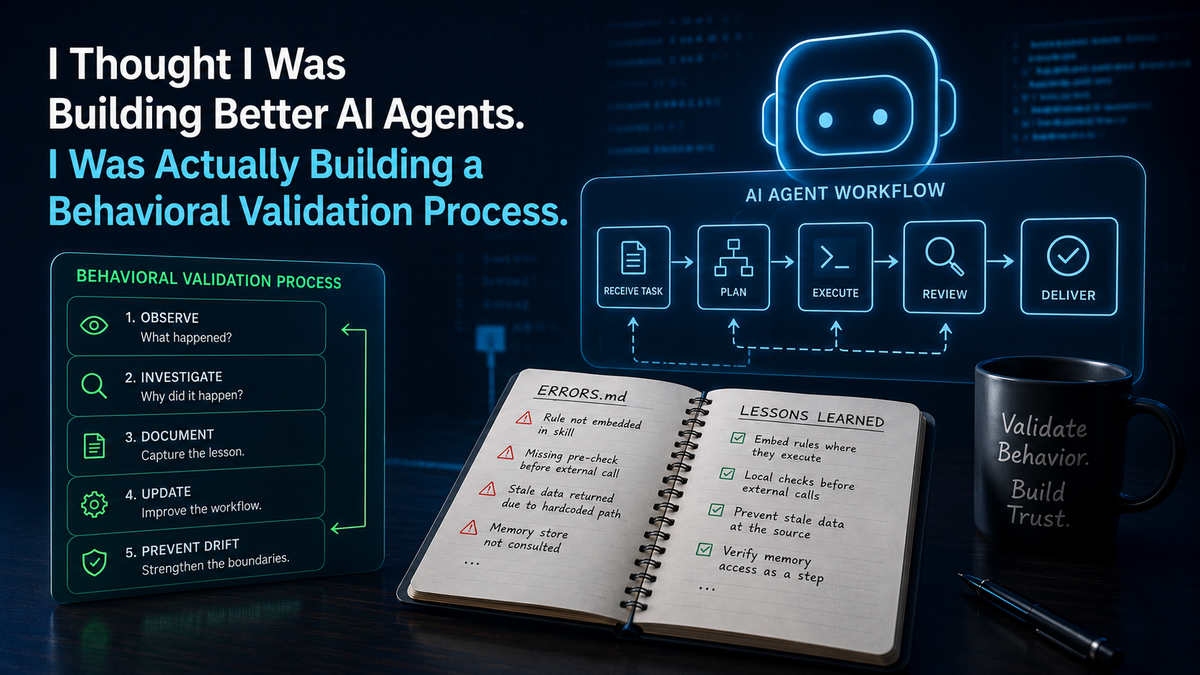
Over the past few months, I've been spending a lot of time building AI agents to help with my own engineering work. Like most people experimenting with agents, I started by trying to make them more capable. Then something interesting happened.
Every once in a while, the agent would do something...odd. It wasn't catastrophic. It wasn't malicious. It was just unexpected.
Sometimes it misunderstood my intent. Sometimes it took a path I didn't expect. Sometimes it confidently produced an answer that didn't align with the way I wanted the workflow to operate. When that happened, I didn't just rerun the prompt. I stopped, investigated what happened, documented the issue in an ERRORS.md file, and updated the workflow so the same mistake wouldn't happen again.
Then I moved on.
At first, I thought I was just improving my prompts. Eventually, I realized I was doing something else entirely. I was building a behavioral validation process.
As a product security engineer, that realization felt familiar. In regulated software, we don't assume that because code compiles, it's ready to ship. We define requirements, verify behavior, evaluate risk, and continue monitoring after release. Without realizing it, I had started applying that same mindset to an AI agent.
Why It Works
This process works because I'm the operator. I built the workflow, I know what the agent is supposed to do, and more importantly, I know when it isn't doing it. The AI doesn't know it has drifted from my expectations. I do. The agent doesn't recognize that a decision is slightly outside the behavior I intended. I do.
Every correction I make isn't teaching the model. It's refining the operating boundaries of my workflow.
Over time, my ERRORS.md file became more than a list of mistakes. It became a record of lessons learned, and a growing behavioral specification for how I expect this particular agent to operate.
Then I Asked a Different Question
What happens when this workflow leaves my laptop?
Suppose I package this agent and distribute it to hundreds or even thousands of engineers. Now who recognizes when something is "off"? Who decides whether the behavior is acceptable? Who determines whether it's a hallucination, prompt injection, an unintended workflow change, or simply a different interpretation of the instructions? Who updates the equivalent of ERRORS.md? Who verifies that the correction didn't introduce another problem?
Suddenly, the challenge isn't building the agent. It's scaling the feedback loop.
AI Behaves Differently Than Traditional Software
With traditional software, a defect usually points back to implementation. With AI agents, the implementation can be correct, verified against every requirement, and behavior can still surprise you.
That gap, between a correctly implemented system and behavior that falls outside our expectations, is where behavioral validation begins. From the outside, to an observer without visibility into the system, a hallucination, prompt injection, an outdated retrieval source, or a poorly designed workflow can all look remarkably similar. Without first understanding the agent's intended behavior, it's difficult to determine whether you're looking at an attack, a design issue, or simply an unexpected but valid outcome.
What Drift Looked Like
Here's what that looked like in practice.
I had built a small organization of subagents to handle pieces of my own engineering and content workflow. A reviewer agent challenged technical decisions. A research agent gathered additional context. Each one did exactly what it had been instructed to do. Nothing was broken.
Then I reviewed a usage report and discovered that over half of my token consumption was coming from subagent-heavy sessions. No one had intentionally designed it that way. It accumulated one reasonable decision at a time until a review process meant to improve quality had quietly become the largest consumer of resources.
I traced it back to two patterns. One review step continued launching additional review rounds without any documented reason for doing so. Another research step executed every time, even when the task didn't require additional research.
Every individual decision looked reasonable in isolation, but the aggregate behavior violated the intent of the system. That's an important distinction. A software bug usually points to a specific implementation defect. This wasn't a defect. It was behavioral drift.
I wrote two small audit tools to measure what was happening, documented the findings the same way I document every lesson learned, and updated the workflow with explicit limits and conditional gates so the same drift couldn't silently accumulate again.
When the Behavioral Validation Process Failed
I assumed that once I had the lesson-logging process in place, the hard part was done. It wasn't.
During a research session, four separate failures surfaced. A fetch tool couldn't parse a JavaScript-rendered page. A URL-confirmation rule I had just documented wasn't followed. A memory store that should have been consulted was ignored. A script returned stale data because of a hardcoded file path.
At first, they looked unrelated. They weren't.
The rule hadn't disappeared. It was documented, and it was in the right place. It just wasn't embedded in the skill that actually executed the task. A rule that isn't embedded where it executes isn't a rule. It's a note.
When I traced the failures, two of them shared the same root cause: a rule written centrally in a shared document doesn't enforce itself unless the skill referencing it treats the rule as a literal execution step. Knowing a rule exists isn't the same as a skill checking it.
The fix wasn't another patch. It was architectural.
I restructured the workflow so a local check always runs before any external call. I added a standing rule that a blocked or unreadable source gets logged and skipped, never a reason to halt the pass entirely. I wrote the general principle back into the workflow documentation and added a dated ERRORS.md entry so the same class of failure, a rule written centrally but never embedded where it runs, couldn't quietly recur on the next skill that gets built.
This is what the behavioral validation process actually requires: not just logging failures, but governing how corrections propagate.
This Isn't Just a Security Problem
My first instinct was to think of this as a security problem. The more I investigated, the less convinced I became. Security certainly matters, but it isn't the central issue.
The central issue is assurance.
Every AI agent is more than the model behind it. It includes its prompts, tools, memory, retrieval system, permissions, business logic, operating policies, and the people who interact with it. Two organizations can deploy the exact same foundation model and end up with completely different risk profiles because everything surrounding the model is different.
That means evaluating the model isn't enough. The entire system has to be understood. Which led me to another realization.
Maybe what we're missing isn't another AI security scanner. Maybe we're missing repeatable engineering frameworks. Not frameworks tied to GPT-5, Claude, Gemini, or any particular model, but frameworks that ask questions like:
- What decisions is this agent allowed to make?
- What tools can it invoke?
- What authority does it have?
- Who is responsible for deciding when the agent's behavior should change?
- What data can it access?
- What assumptions is it operating under?
- What behaviors are expected?
- What behaviors are unacceptable?
- What telemetry demonstrates it's operating correctly?
- How do we recognize behavioral drift?
- How do we capture lessons learned and feed them back into the system?
Notice that none of those questions depend on the underlying model. They depend on understanding the system. That's what makes them scalable.
Looking Ahead
Looking back, I realized I wasn't just fixing problems. First I observed unexpected behavior. Then I corrected it. Eventually, I started improving the process that produced those corrections.
The behavioral validation process itself became something that needed to be designed, reviewed, and continuously refined. That's when I realized I hadn't spent the past few months teaching an AI agent how to behave. I'd spent the past few months learning how to validate its behavior.
That's manageable because I'm the operator. I know what the agent is supposed to do, and I know when it has drifted from my expectations. An enterprise doesn't have that luxury.
If hundreds or thousands of employees are using AI agents, the organization can't rely on individual intuition to recognize when behavior has changed. It needs repeatable processes that define expected behavior, detect when that behavior changes, determine whether the change is acceptable, document lessons learned, and continuously validate that the agent is still operating within its intended operating envelope.
In traditional software development, we validate code before release. We perform code reviews, run automated tests, execute security scans, and review risk. Only then do we ship.
AI agents introduce a different challenge. The implementation may be correct. The security testing may pass. The infrastructure may be sound. The behavior may still be unexpected.
Perhaps the next evolution isn't simply securing AI agents. Perhaps it's behaviorally validating them before release, then continuously validating that behavior throughout their operational life. Not until an agent is perfect. I don't think they'll ever be. Instead, they become behaviorally validated for a defined operating envelope.
If that's true for a single operator working on a single workflow, I suspect organizations deploying hundreds or thousands of AI agents will eventually need a repeatable way to do the same.
That leaves me with a question I don't yet have the answer to.
If organizations are going to trust autonomous AI systems, what does a repeatable behavioral validation process look like before deployment? How do we define expected behavior, recognize when it changes, decide whether that change is acceptable, and continuously validate the system as it evolves?
I don't have the answer yet. But I have a feeling those are some of the engineering problems we'll be solving over the next decade.
Where My Thinking Went Next
After I finished writing this article, I found myself continuing to think about the question I ended with. If behavioral validation really is something organizations will eventually need, what might that process actually look like?
I don't think I have the answer yet, and I certainly don't think this is a complete framework. It's simply where my thinking is today. If I were starting from scratch and trying to build a repeatable behavioral validation process, this is probably where I'd begin.
1. Start with the Individual Operator
The first place I'd start isn't with an enterprise. It's with the way I already work.
One of the more useful habits I've developed is keeping an ERRORS.md file whenever I discover unexpected behavior. Looking back, I think that document could evolve into something much more useful than a running list of mistakes. Over time, it becomes a behavioral specification that captures how the workflow is expected to operate.
For every issue, I'd want to capture the incident itself, the root cause of the drift, the intended behavior, the remediation that was implemented, the verification steps used to confirm the issue was resolved, and the date and version where the change was introduced. Eventually, the document stops being about failures and starts becoming a history of how the workflow has evolved.
Another lesson from this project was that documenting rules centrally isn't enough. A rule that only exists in documentation isn't guaranteed to be followed. Every skill or subagent should include the behavioral guardrails it actually depends on. If a workflow always needs to check local memory before making an external request, validate a URL before accessing it, or log the outcome of a tool call, those shouldn't be suggestions buried in a shared document. They should be explicit execution steps inside the skill itself.
I'd also want every workflow to identify which rules apply before it begins. Instead of assuming the agent remembers them, I'd rather have it explicitly list the applicable rules, confirm each one, and then continue with the task.
The other area I'd continue investing in is visibility. I've already written a couple of small audit tools, and I think they're pointing in the right direction. I'd expand those into simple utilities that measure token and step counts for every subagent, capture structured decision logs showing which tools were invoked and why, and compare the workflow I expected against the one that actually executed. The more observable the workflow becomes, the easier it is to recognize behavioral drift before it turns into a larger problem.
2. Make Behavioral Validation Repeatable
Once the process works for one person, the next challenge is making it repeatable.
I'd probably start every workflow with an Agent Charter that clearly defines its operating envelope. That charter would answer questions like what decisions the agent is allowed to make, which tools it can invoke, what authority it has, which behaviors are unacceptable, and what success looks like, whether that's measured in quality, cost, speed, safety, or some combination of all four. Every subagent would reference the same charter so the expectations remain consistent across the entire workflow.
Before promoting a workflow into regular use, I'd validate it much the same way we validate traditional software. I'd want to run a variety of normal, edge case, and adversarial scenarios, compare the results against the charter, review execution traces for signs of behavioral drift, and simulate larger-scale usage to see whether unexpected patterns begin to emerge over time. Many of the issues I've encountered weren't obvious during a single execution. They only became visible after looking at the aggregate behavior.
Validation also shouldn't stop after deployment. I'd want telemetry for tool calls, rule checks, token usage, cost spikes, and user corrections. Automated alerts could identify sudden increases in resource consumption or workflows that begin taking unexpected paths, while periodic reviews after major model updates would help determine whether the system is still operating within its intended behavioral boundaries.
3. Scale Beyond One Person
Things become considerably more interesting once multiple people begin building and operating agents.
I'd want shared knowledge to be more than documentation sitting in a repository. A Behavioral Library could version common rules alongside the workflows that depend on them, allowing each skill to reference only the guidance it needs while also verifying those rules during execution. The goal isn't simply to document behavior. It's to make the documentation executable.
Ownership also becomes important. Someone needs to be responsible for maintaining the Agent Charter and validating behavioral changes over time. Users should have an easy way to report when something feels off, ideally generating a draft ERRORS entry that can be investigated later. Significant changes to shared agents should probably go through some form of governance review before they become the new baseline.
Testing would continue well beyond deployment. I'd want a sandbox environment where agents operate with restricted permissions and much more detailed logging, regular red-team exercises that intentionally attempt to push workflows outside their intended operating envelope, and a regression suite capable of replaying previous failure scenarios to verify they remain fixed.
Finally, I'd treat prompts, tools, Agent Charters, and behavioral specifications the same way we treat software. They should all be versioned, reviewed, and easy to roll back whenever unexpected behavior appears after a model update or workflow change.
4. Build Better Visibility
There are also a handful of supporting capabilities that feel increasingly important as these systems become more sophisticated.
Structured outputs make behavioral traces easier to analyze consistently. Tool hooks before and after execution provide natural places to enforce guardrails. Memory and retrieval systems should always have access to the latest behavioral specification so agents are operating against current expectations rather than outdated guidance. Dashboards that balance cost, quality, and operational behavior can make subtle trends visible long before they become incidents.
For larger deployments, I also expect we'll see more frameworks focused specifically on agent observability and behavioral evaluation. Those tools are still evolving, but they seem like a natural extension of the same validation process.
None of this feels complete, and I fully expect parts of it to change as I continue building AI workflows. But if someone asked me where I'd begin today, this is probably the process I'd start experimenting with.